
Introduction
When you or someone you love receives a cancer diagnosis, treatment decisions feel enormous — because they are. Two of the most commonly discussed options are radiation therapy and chemotherapy. Both are proven, widely used treatments. Both have their place. And yet they are fundamentally different in how they work, what they target, and how they affect the body.
Understanding the difference between radiation therapy and chemotherapy — not in overly technical terms, but in a way that actually helps you have a real conversation with your doctor — is one of the most useful things you can do at the start of this journey.
This guide is for patients and families. It is not meant to replace your oncologist’s advice, but to give you the foundation to understand it.
How Chemotherapy Works?
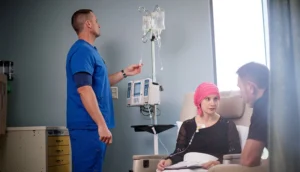
Chemotherapy uses drugs — chemical agents — to kill cancer cells or prevent them from dividing. These drugs are introduced into the body, most commonly through an IV infusion, though some are taken as oral pills.
Once in the bloodstream, chemotherapy drugs travel throughout the body. This is both a strength and a limitation. The systemic nature of chemo makes it effective against cancers that have spread — or may have spread — to areas beyond where the original tumor is located. This includes cancers that have metastasized to lymph nodes, organs, or bones.
However, because chemo travels everywhere in the body, it affects healthy, fast-dividing cells too — not just cancer cells. Hair follicle cells, digestive tract cells, and bone marrow cells all divide rapidly, which is why hair loss, nausea, and fatigue are such common side effects. The treatment cannot distinguish between a cancer cell and a healthy cell that simply divides frequently.
How Radiation Therapy Works
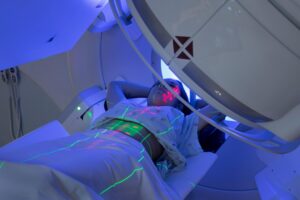
Radiation therapy uses high-energy waves — most commonly X-rays generated by a linear accelerator — to damage the DNA inside cancer cells. When cancer cells’ DNA is damaged beyond repair, they can no longer divide and eventually die.
Unlike chemotherapy, radiation therapy is a local treatment. It targets a specific area of the body — the tumor and a small margin of surrounding tissue. This precision means it is highly effective for destroying a tumor in a defined location while minimizing impact on the rest of the body.
At Curepoint Cancer Center in Dublin, Georgia, radiation is delivered using state-of-the-art linear accelerator technology that allows sub-millimeter targeting — meaning the beam is shaped to match the tumor’s contour from multiple angles, concentrating the dose exactly where it is needed.
When Is Chemotherapy the Better Choice?
Chemotherapy tends to be the better option when:
- The cancer has spread (metastasized) to multiple areas of the body and cannot be targeted by a localized approach
- The cancer type is known to respond well to chemotherapy drugs (such as certain leukemias, lymphomas, or germ cell tumors)
- Treatment is intended to shrink a tumor before surgery (neoadjuvant chemotherapy) or eliminate microscopic remaining cells afterward (adjuvant chemotherapy)
- Radiation therapy is not technically feasible due to tumor location or previous radiation in the area
When Is Radiation Therapy the Better Choice?
Radiation therapy tends to be the better option when:
- The cancer is localized — contained to one area or organ
- The goal is to eliminate a tumor while preserving surrounding healthy tissue
- The patient is not a surgical candidate but local treatment is still appropriate
- Radiation is used as a primary treatment for cancers that respond particularly well to it — such as certain prostate, head and neck, or early-stage lung cancers
- Palliative care is the goal — using radiation to shrink a tumor that is causing pain or pressure, even if a cure is not the primary aim
Curepoint specializes in radiation therapy for many cancer types, including prostate cancer, breast cancer, lung cancer, and head and neck cancer.
Can Both Be Used Together?
Absolutely — and for many cancers, this combination is the standard of care. Concurrent chemoradiation, where both treatments are given simultaneously, is used for cancers such as cervical cancer, locally advanced head and neck cancer, and some lung cancers.
In these cases, chemotherapy serves a dual purpose: it kills cancer cells systemically and also acts as a radiosensitizer — meaning it makes cancer cells more vulnerable to the radiation being delivered at the same time. The two treatments work synergistically, often producing better results than either alone.
Your oncology team will discuss whether a combined approach is appropriate for your specific diagnosis, stage, and overall health.
Side Effects: A Realistic Comparison
This is often what patients most want to understand before making any decision.
Chemotherapy side effects tend to be systemic and can include nausea, vomiting, fatigue, hair loss, increased risk of infection (due to bone marrow suppression), mouth sores, and neuropathy. The severity depends on the specific drugs used and the dosage.
Radiation therapy side effects tend to be localized to the area being treated. Skin changes, fatigue, and temporary irritation of nearby tissues are most common. Because the beam is targeted, radiation does not cause the body-wide side effects of chemotherapy — hair loss, for example, only occurs if the scalp is being treated.
Neither treatment is without challenge. But the precision of modern radiation therapy means that many patients are surprised by how manageable the side effects are — particularly when they had been bracing for chemotherapy-level impact.
Questions to Ask Your Oncologist
If you are preparing for a treatment discussion, consider asking your oncologist these questions:
- Is my cancer localized, or has it spread beyond the primary site?
- Would radiation, chemotherapy, or a combination give me the best chance of cure or control?
- What are the expected side effects for each option in my specific situation?
- Is surgery also part of the conversation?
- What does the treatment schedule look like — how many sessions, over how many weeks?
- Are there clinical trials I should know about?
There are no wrong questions. The more you understand your options, the better you can participate in decisions about your own care.
Personalized Cancer Treatment at Curepoint
At Curepoint Cancer Center, we believe deeply that no two cancer diagnoses are the same — and therefore no two treatment plans should be the same. Our oncologists take time to understand your specific tumor, your health history, your values, and your goals before recommending a treatment path.
Whether your care involves radiation therapy alone, in combination with chemotherapy, or as part of a broader plan, every aspect of your experience at Curepoint is designed with your well-being in mind. We offer comprehensive support services — not just medical treatment, but the emotional, nutritional, and psychological support that carries people through this journey.
Read more about our cancer care approach and our vision for patient-centered oncology.
Reach Out — We Are Here
If you have received a cancer diagnosis and are trying to understand your options, please reach out to us. You do not have to figure this out alone, and you do not have to travel hours away from home for world-class care.
Curepoint Cancer Center is located at 2406 Bellevue Avenue, Suite 7, Dublin, Georgia 31021. Call us at (478) 272-2255. We are here to answer your questions, explain your options, and stand with you through every step of treatment.